

What is an API ? The Simplest Explanation!
If you're an engineer, you interact with API's daily. But do you know what they are?

What is an API ?
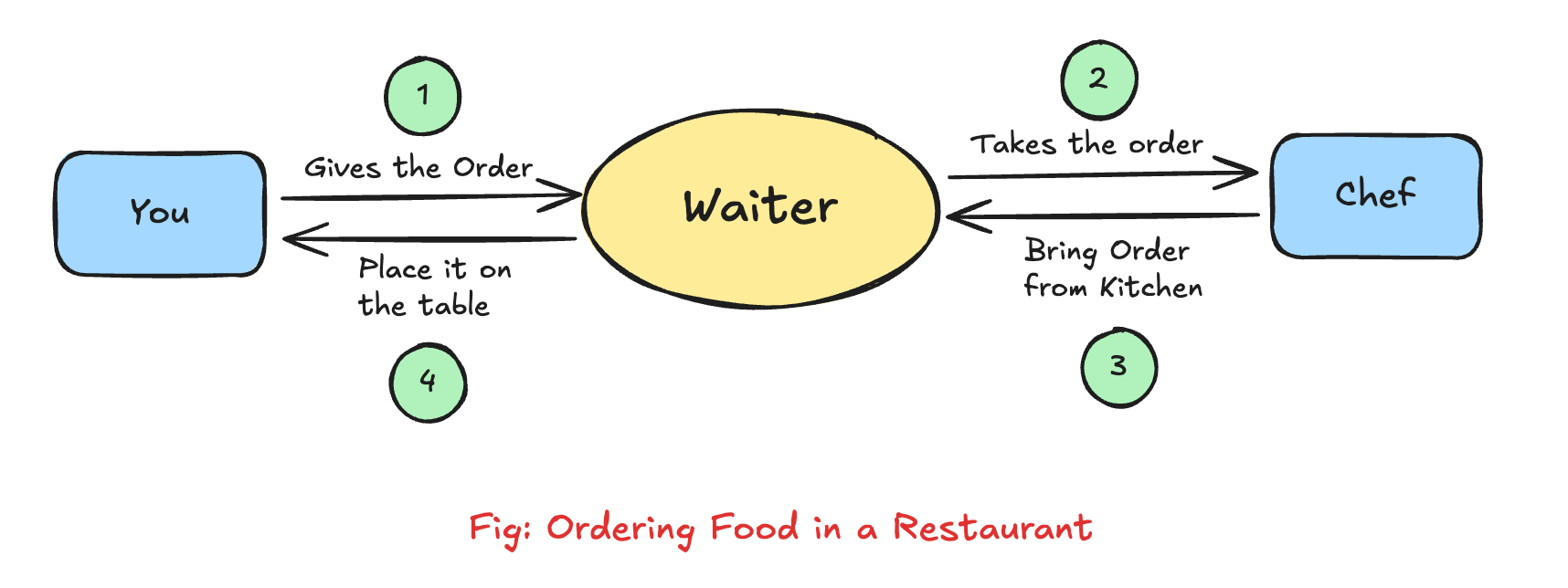
Have you ever ordered food at a restaurant? You check the menu, tell the waiter what you want, and after some time, your food arrives. You don’t need to know what’s happening in the kitchen—just that your order gets processed and delivered.
An API (Application Programming Interface) works the same way!
It allows two applications to talk to each other. One application requests something, and another application delivers the response, just like a waiter in a restaurant. APIs help different systems interact seamlessly, ensuring that the right information gets to the right place without requiring users to understand the complexities behind the scenes.
Real-Life Analogy
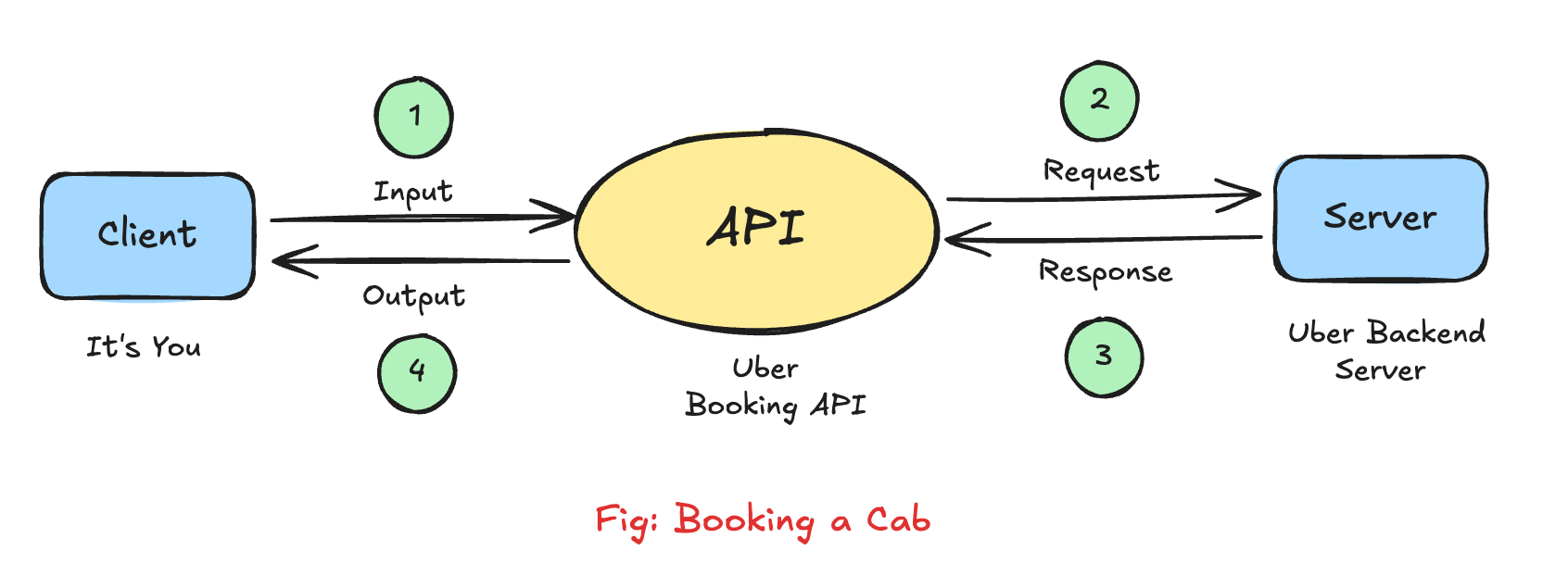
Imagine you want to go from Indiranagar to Koramangala in Bangalore, so you open the Uber app and book a cab. What happens behind the scenes is a conversation between your app and Uber’s backend servers, all made possible by APIs.
Here’s how it works:
Input (Client Side - You) : You enter your pickup i.e. Indiranagar and destination locations i.e. Koramangala in the Uber app. This information is sent to Uber’s Booking API as a request.
Request (API to Server) : The Uber Booking API forwards your request to Uber’s backend servers. The system checks for available drivers, calculates the estimated fare, and determines how long it will take for a driver to reach you.
Response (Server to API) : The backend server finds the nearest driver and confirms the ride details. The response is sent back to the API.
Output (API to Client) : The Uber app receives the response and displays the driver’s name, car details, estimated fare, and arrival time. Your ride is now booked, and you can track your driver in real time.
APIs make this entire process seamless, allowing you to request a ride in seconds without worrying about how everything works behind the scenes.
Why are API’s Important?
Now you are thinking, why we actually need the API’s ?
It offer several advantages that make modern applications more efficient, secure, and scalable:
Saves Time: Developers don’t need to build everything from scratch. Instead of creating complex functionality from the ground up, they can integrate existing APIs to add features quickly.
Connects Different Services: APIs enable apps to work together, creating seamless digital experiences. Without APIs, services would be isolated and unable to interact.
Enhances Security: APIs control what data can be accessed and how it is shared, reducing the risk of unauthorized access.
Supports Scalability: APIs help businesses expand their services efficiently. For example, an e-commerce store can integrate multiple payment gateways via APIs rather than building its own payment infrastructure.
Enables Automation: APIs allow software to interact without human intervention. Think of chatbots, automated email responses, or stock market apps fetching real-time financial data, all powered by APIs.
Types of API’s
API Types Based on Accessibility :
Open APIs (Public APIs) – Available for anyone to use, like Google Maps API or OpenWeather API.
Private APIs – Used internally by a company to connect its own services, like an API connecting a company’s mobile app to its database.
Partner APIs – Shared between specific business partners to facilitate integrations such as a travel booking API used by airlines and hotels.
Composite APIs – Combine multiple API calls into a single request to improve efficiency and reduce server load.
API Types Based on Architecture :
APIs are also categorized based on how they are designed and structured. The most common architectural types include:
REST (Representational State Transfer) – The most widely used API type that follows standard HTTP methods (GET, POST, PUT, DELETE). RESTful APIs are simple, scalable, and widely adopted in web applications.
SOAP (Simple Object Access Protocol) – A protocol that allows applications to communicate over XML-based messages. SOAP APIs are often used in enterprise applications that require high security and strict contracts.
GraphQL – Developed by Facebook, GraphQL allows clients to request only the data they need, reducing over-fetching and under-fetching issues common in REST APIs.
gRPC – A high-performance API framework developed by Google that uses protocol buffers instead of JSON or XML, making it more efficient for real-time services and microservices communication.
WebSockets – A protocol that enables real-time, two-way communication between a client and a server, often used in chat applications and live notifications.
Congratulations 🥳! By now, you should have a clear understanding of how APIs work and why they are essential in modern technology. But theory alone isn't enough—real learning happens when you put it into practice.
Try building an API that fetches real-time stock market trends, creates personalized workout plans, or even curates your favorite recipes from multiple sources. The best way to master APIs is by experimenting and creating something useful.
If you want to stay ahead with insights on coding, system design, and the latest software trends, Subscribe To My Newsletter 🚀—where I break down complex tech topics into simple, actionable knowledge.
See you next Monday with more exciting content!
If you’ve made it this far, here’s a bonus for you:
Job Openings! 🚀
Software Engineer, Infrastructure, Google Ads @Google:
https://www.linkedin.com/jobs/view/4157536518Software Engineer II @Microsoft:
https://www.linkedin.com/jobs/view/4118388938Frontend Engineer @Razorpay:
https://www.linkedin.com/jobs/view/4166300525Computer Scientist-I (Frontend) @Adobe:
https://www.linkedin.com/jobs/view/4163586705Associate Engineer - Frontend @PayPal:
https://www.linkedin.com/jobs/view/4166256744Software Development Engineer I @Amazon:
https://www.linkedin.com/jobs/view/4161408678
Loved it bro, best for 1min revision. Keep publishing more!